2026 Tax Changes for Homeowners: Who Actually Benefits
Educational overview. Not individualized financial, legal, or tax advice. How we source and check numbers.
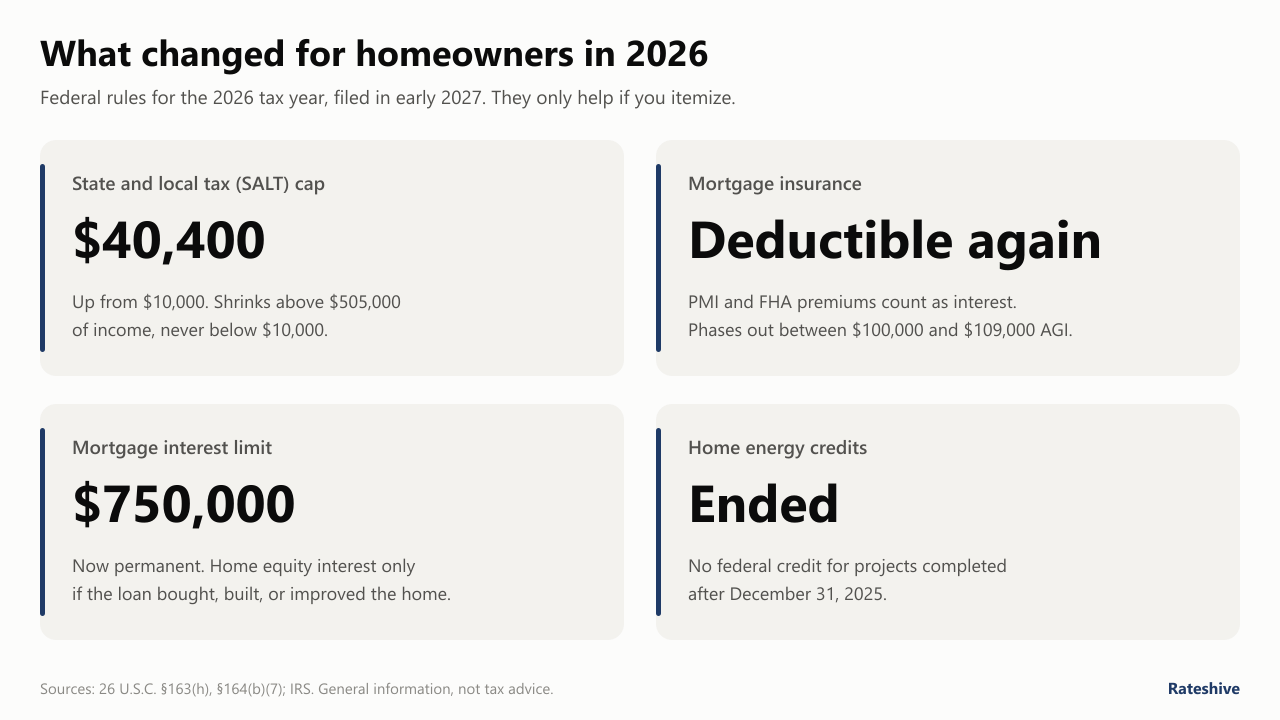
The tax law Congress passed in July 2025 changed several rules that matter to homeowners, and most of them took effect for the 2026 tax year, which you file in early 2027. Some households will save real money. Many will see no difference at all, because they take the standard deduction. This guide sorts out which group you are in.
First question: will you itemize?
Every change below is an itemized deduction. It only helps if your itemized deductions add up to more than the standard deduction, which for 2026 is $32,200 for married couples filing jointly and $16,100 for single filers. For 2027 the IRS has set it at $33,200 and $16,600.
For homeowners, itemizing usually comes down to three numbers: mortgage interest, state and local taxes, and charitable giving. Interest is front-loaded. On a new $400,000, 30-year loan at 7.18%, the first year's interest is about $28,600. On a $250,000 loan at the same rate it is about $17,900; add $4,500 of property and state income tax and you reach $22,400, well short of $32,200. That household gets nothing from any of the changes below.
The changes, one at a time
State and local taxes: the cap rose from $10,000 to $40,400
The deduction for property taxes plus state income (or sales) taxes was capped at $10,000 from 2018 through 2024. For 2025 the cap became $40,000, and for 2026 it is $40,400 ($20,200 if married filing separately). It rises 1% a year through 2029, then returns to $10,000 in 2030 unless Congress changes it again.
Higher earners get less of it. For 2026 the cap shrinks by 30 cents for every dollar of modified adjusted gross income above $505,000, but never below $10,000. At $560,000 of income the cap is $23,900. At about $606,000 and above it is back to $10,000.
Mortgage insurance is deductible again
Premiums for private mortgage insurance, FHA mortgage insurance, and VA and USDA guarantee fees are once again treated as mortgage interest, starting with 2026. The deduction had lapsed after 2021. It shrinks by 10% for each $1,000 (or part of $1,000) of adjusted gross income above $100,000, so it is gone entirely above $109,000 ($54,500 if married filing separately). It applies to policies issued after 2006.
Mortgage interest limits are now permanent
Interest on up to $750,000 of debt used to buy, build, or improve your main home and one second home stays deductible ($375,000 if married filing separately). Loans taken out on or before December 15, 2017 keep the older $1 million limit. Before the 2025 law, the $750,000 limit was scheduled to go back to $1 million in 2026; it no longer will.
The rule on home equity loans and lines of credit is also permanent: interest is deductible only if the money was used to buy, build, or substantially improve the home that secures it. Interest on a HELOC used to pay off credit cards or a car is not deductible.
The home energy credits ended
The two federal credits for home energy upgrades were cut off after 2025. The Energy Efficient Home Improvement Credit (heat pumps, insulation, windows, and similar work, up to $3,200 a year) does not apply to property placed in service after December 31, 2025. The Residential Clean Energy Credit (30% of the cost of solar panels, battery storage, and similar systems) does not apply to expenditures made after that date. A project finished in 2026 does not qualify. State and utility rebates are separate and may still be available.
Disaster losses: state-declared disasters now count
Personal casualty losses, such as uninsured damage to your home, have only been deductible since 2018 when they came from a federally declared disaster. Beginning in 2026, losses from state-declared disasters can qualify too. The usual limits still apply, so a loss has to be large relative to your income before it produces a deduction.
What did not change: selling your home
The exclusion on profit from selling your main home is still $250,000 for single filers and $500,000 for married couples filing jointly, if you owned and lived in the home for two of the last five years. Bills to raise or remove those limits have been introduced, including the No Tax on Home Sales Act, but as of November 2026 none has become law.
Four households, worked through
The figures below are illustrations using 2026 rules and first-year interest on a 30-year fixed loan at 7.18%. Your own numbers will differ.
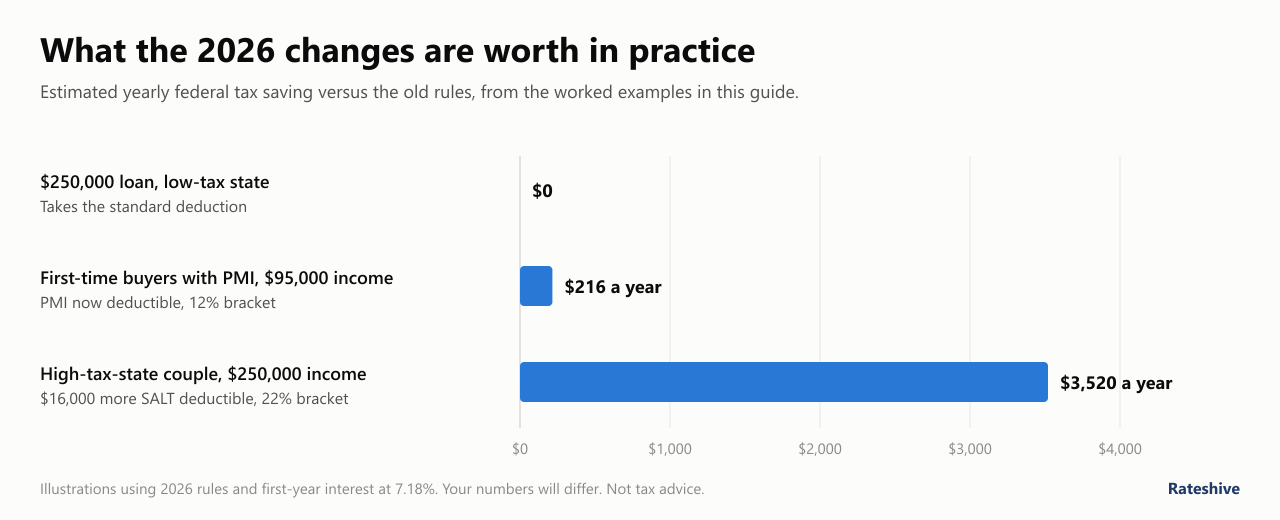
- First-time buyers with PMI, $95,000 income, married filing jointly. A $400,000 loan carries about $28,600 of first-year interest. With $5,500 of property tax and $4,000 of state income tax, their state and local taxes are $9,500, under even the old cap. The new rules add their $1,800 of PMI, lifting itemized deductions from about $38,100 to $39,900. In the 12% bracket that is worth about $216 a year. Helpful, not life-changing.
- A high-tax-state couple, $250,000 income. A $600,000 loan carries about $42,900 of first-year interest. They pay $12,000 of property tax and $14,000 of state income tax. Under the old cap they could deduct $10,000 of that; now they can deduct all $26,000. The extra $16,000 of deductions saves about $3,520 at a 22% rate. Their income is too high for the mortgage insurance deduction.
- A $560,000 earner. Their cap is $23,900, not $40,400, because of the income phase-down. If they pay $45,000 in state and local taxes, the most they can deduct is $23,900.
- A $250,000 loan in a low-tax state. As above, about $22,400 of deductions against a $32,200 standard deduction. They take the standard deduction, and none of the 2026 changes affect them.
What to do before year end
- Add up your likely 2026 itemized deductions now, using your Form 1098 interest to date and your property tax bills. If the total is close to the standard deduction, paying a property tax installment or a charitable gift in December rather than January can tip it over. Check that your county accepts early payment.
- If you pay PMI and your income is near $100,000, the phase-out matters. A few hundred dollars of income can reduce the deduction.
- If you planned an energy upgrade expecting a federal credit, check state and utility programs instead.
- If you are paying down PMI, the cancellation rules in PMI basics still matter more than the deduction: removing PMI saves the whole premium, not a percentage of it.
A deduction is a discount on taxes, not a refund of what you spent. Most homeowners still come out ahead by keeping the housing payment low rather than chasing a write-off.